
Judo Braille
Judo & Braille: Empowering Paths to Inclusion


JudoBraille – Making Judo Accessible for Everyone
Over 30 million people in Europe live with vision impairments. Many dream of training in judo, yet lack adapted resources and qualified coaches.
JudoBraille is changing that.
We are creating:
- Braille belt exam guides and other accessible learning materials
- Multilingual resources tailored for blind and visually impaired judokas
- Training programmes for coaches on inclusive, safe, and effective teaching methods
Partners from Croatia, Lithuania, Slovenia, and Spain are joining forces, supported by National Paralympic Committees and Judo Federations. Judo is more than an Olympic and Paralympic sport – it builds confidence, spatial awareness, safe falling techniques, and real social inclusion.
Together, we are making judo truly inclusive – today and for the future.
Project outcomes will be transferable to other sports and countries, built sustainably with environmentally friendly practices.
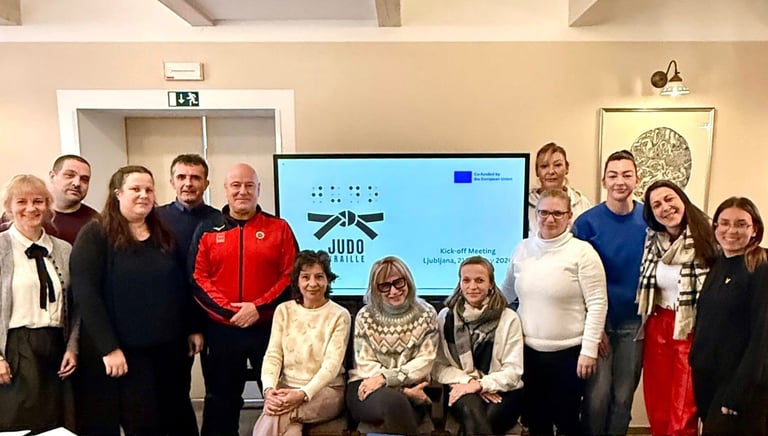
Slovenian capital welcomed the official launch of JudoBraille, a two-year Erasmus+ Sport project aiming to make judo fully accessible to blind and visually impaired athletes across Europe.
JudoBraille brings together leading organisations from across the continent: Judo Klub Golovec and Center IRIS (Slovenia), Club Deportivo Elemental Newton (Spain), Kaunas Judo Club Ryto Saulė (Lithuania), and Judo Klub Osoba s Invaliditetom Yuki (Croatia). Associated partners include the Slovenian Paralympic Committee, Croatian Judo Federation, Madrid Judo Federation, and Lithuanian Paralympic Committee, institutional support ensuring the project’s reach extends beyond individual clubs into national structures.
At the kick-off meeting, partners shared expertise, explored collaboration strategies and participated in practical sessions demonstrating inclusive judo techniques. Theory met practice.
JudoBraille is a practical intervention designed to remove specific barriers:
Accessible Belt Exam Guides: Transcribing examination materials into Braille and other accessible formats, ensuring visually impaired judoka can pursue grading progression independently and with dignity.
Coach Training & Curriculum Development: Equipping coaches with skills to adapt techniques, enhance communication methods, promote safety protocols and build confidence for VI athletes navigating a sport traditionally taught through visual demonstration.
JudoBraille Project Launches in Ljubljana
JudoBraille Partners Meet in Madrid
JudoBraille partners met in Madrid from 16–18 September for the project’s second Transnational Meeting, hosted by Club Deportivo Elemental Newton in cooperation with the Madrid Judo Federation.
Alongside work on the accessible Judo Belt Exam Guides and coach education curriculum, partners took the project directly to the tatami. A joint training session brought together project coaches and 12 blind and visually impaired judoka, led by Marina Fernández Ramírez, Technical Director and Head Coach of the Spanish Paralympic Judo Team.
From project development to pracsportanddev tatami.
Read more about JudoBraille on sportanddev: https://shorturl.at/GxWAl


Blind and visually impaired judoka already compete at elite levels, including Paralympic Games but grassroots accessibility determines whether future champions ever step onto a mat. If belt exams remain inaccessible, if coaches lack inclusive training methods, if materials exist only in visual formats, then talent is wasted and potential is squandered.
JudoBraille addresses these gaps systematically, creating resources that will outlast the project’s two-year timeline and benefit athletes across Europe for years to come.


Follow us on social media
© 2026. All rights reserved.
Funded by the European Union. Views and opinions expressed are however those of the author(s) only and do not necessarily reflect those of the European Union or the European Education and Culture Executive Agency (EACEA). Neither the European Union nor EACEA can be held responsible for them.